Unlocking AI for All and Bringing Value Within Reach
AI’s real value comes from giving organizations the freedom to choose tools that fit specific needs rather than from building ever-larger models. Flexibility and human-centred design are now shaping how AI delivers impact at scale.
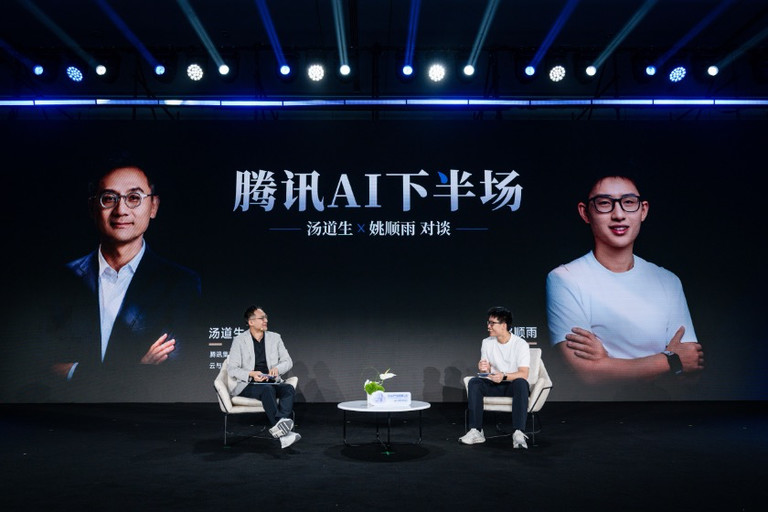
At the World Economic Forum this year, Dowson Tong, Senior Executive Vice President of Tencent and CEO of its Cloud and Smart Industries Group, shared “When people talk about AI,” he said, “we tend to think of one big super system, something like AGI. But in reality, there are many different types of models that serve different purposes.”
That distinction matters, because it reflects how AI is creating value today.
 Watch the replay of the China’s AI+ Economy panel at the World Economic Forum 2026.
From One Model to Many Real-world Needs
In practice, AI adoption looks far more diverse than the idea of a single super system. Different industries – and often different teams within the same organization – require different capabilities.
At Tencent, this diversity is already visible in day-to-day work. Engineers use AI coding assistants to accelerate development and deliver features faster. But they are not alone.
“It’s not just programmers,” Dowson noted. “Product managers, designers, accountants – people across different roles are already using these tools to automate their work and enhance individual productivity.”
In many cases, teams are building tools that would not have been possible before. Retail companies are using generative image and 3D technologies to shorten product design cycles. Marketing teams are improving return on investment through better targeting and more personalized experiences. In healthcare, AI is already supporting areas such as drug discovery, helping researchers move faster while managing complexity.
Across sectors, the pattern is consistent: AI delivers the greatest value when it is applied with intention. These are not experiments. They are practical applications delivering measurable improvements today.
Lowering Barriers So AI Can Scale Responsibly
As adoption grows, enterprises are highly focused on efficiency and return on investment. If AI is too expensive or too complex to deploy, it will remain confined to pilots rather than becoming part of everyday operations.
Dowson explained. “If the cost of using AI is too high, it simply won’t scale.” This is where ecosystem design becomes critical.
Over the past 18 months, strong participation in open-source communities have helped drive down the cost of AI inference. As costs fall, AI becomes more accessible – not only for large enterprises, but also for smaller companies and developers.
Tencent’s approach reflects this reality. Rather than locking customers into a single model, the company focuses on building open platforms that support a wide range of AI models.
“Customers want choices,” Dowson said. “Different use cases need different models. Our role is to give the power of choosing the right model back to the hands of the customer.”
The shift is significant: control moves away from platforms and back to the people using the technology.
Learning to Work with AI, Not Around It
The long-term impact of AI will depend not only on technology itself, but on how people learn to use it.
Increasingly, younger generations are developing AI literacy outside traditional classrooms. “The new generation is learning AI not only in schools,” Dowson observed, “but by using freely accessible tools to ask questions and explore their curiosity.”
This builds familiarity and confidence – not just with AI outputs, but with the process of working alongside intelligent systems.
Over time, these habits matter. Learning to use AI effectively begins with learning how to ask better questions: how to frame problems, test assumptions, and evaluate results. These skills are becoming as essential as technical knowledge itself.
Encouraging curiosity and responsible experimentation helps ensure AI becomes a practical learning companion, rather than a black box.
Scaling Impact Without Leaving People Behind
AI leadership will not belong to organizations chasing benchmarks or scale alone. It will belong to those with a long-term mindset – ones that focus on integration, efficiency, and real-world outcomes.
By prioritizing choice, lowering barriers to adoption, and keeping people at the center of design, AI can move from abstract promise to practical progress – steadily, through thousands of small, everyday improvements that add up to meaningful change.
Related Articles

Tencent Hunyuan Officially Releases Hy3, Advancing Agent Capabilities and Deeper Product Integration
2026.07.06

World Economic Forum and Tencent Cloud Collaborate to Enhance the Digital Experience for Summer Davos 2026 in Dalian
2026.06.23