Tencent Backs Next-Gen Decarbonization Innovators with Catalytic Funding Through CarbonX 2.0 and Advances Progress Towards Climate Goals
- 16 climate teams will share nearly US$30 million in funding, with expertise, resources and industry partnerships to scale breakthrough climate solutions
- Tencent achieved emissions reductions in 2025, even as AI-driven demand for compute and energy accelerated
Today, Tencent announced 16 winners of CarbonX 2.0, a global initiative designed to help promising climate solutions grow and scale. The winners will receive a share of nearly US$30 million in catalytic funding, supported by technical resources, expert networks, and opportunities to pilot and scale their solutions for real-world impact. The announcement was made at a flagship event at the London Science Museum, co-hosted with TED during London Climate Action Week 2026.
CarbonX 2.0 Winners
CarbonX 2.0 received 660 applications from 54 countries and regions across six continents. A cohort of 50 finalists was identified, before 16 winners were selected to receive the critical funding and resources needed to scale their solutions from pilot to real-world deployment.
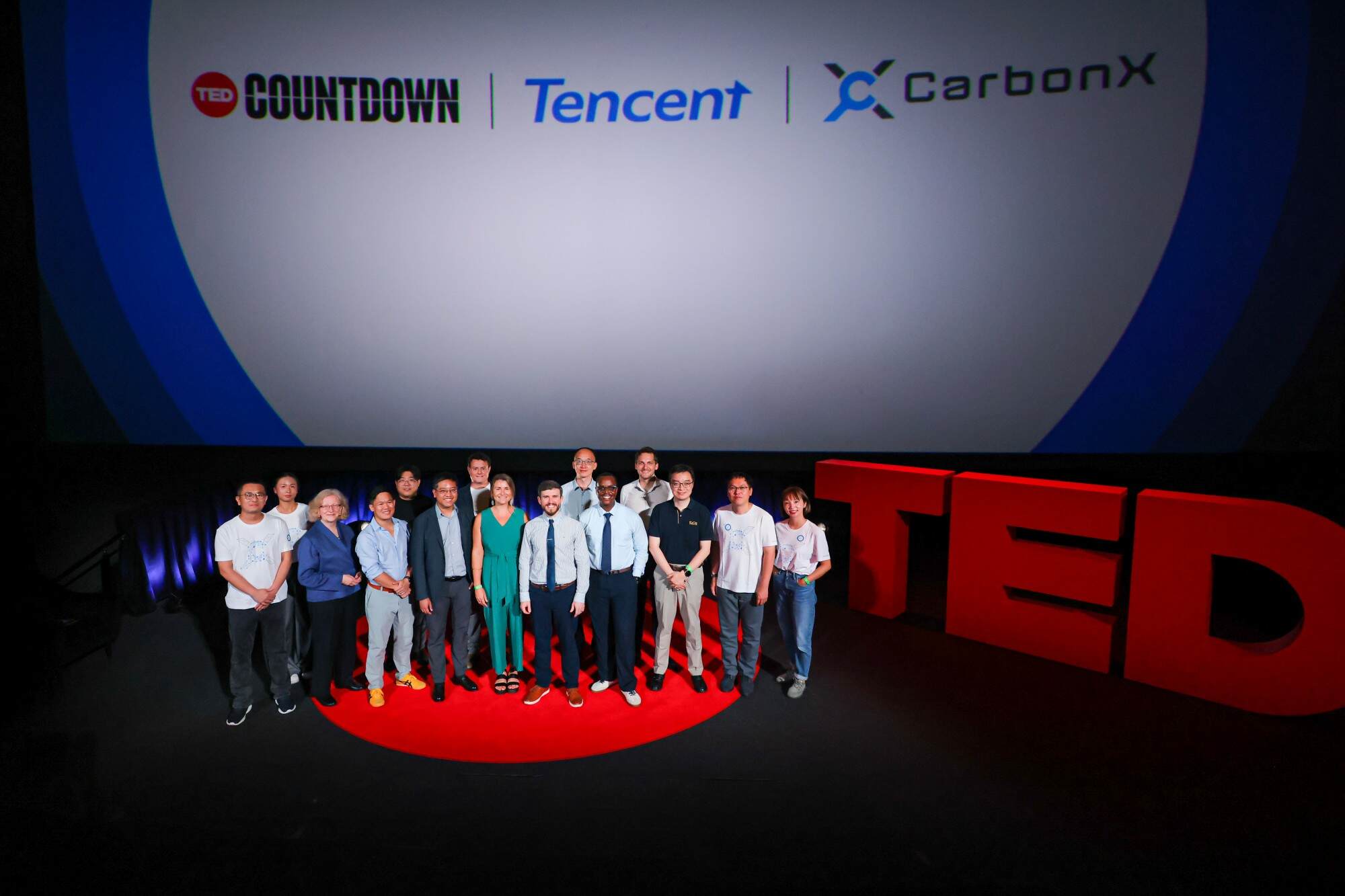 Winning teams of CarbonX 2.0 showcase their climate-tech innovations.
Ten of the 16 teams span four critical technology areas:
- Carbon Dioxide Removal (CDR) – technologies that remove CO₂ directly from the atmosphere, with pilots in Kenya
- CCUS for Steel – solutions to reduce emissions in one of the hardest‑to‑abate industrial sectors, with pilots in Serbia and China
- Carbon Utilization (CCU / CarbonXmade) – converting captured CO₂ into useful materials and products
- Long‑Duration Energy Storage (LDES) – enabling stable, 24/7 renewable energy systems, with pilots in the Maldives
Six additional teams were selected to receive tailored support, including Measurement, Reporting and Verification (MRV), carbon-credit procurement commitments, and green-premium subsidy mechanisms.
From utilizing geothermal energy to capture CO₂, to creating a water-based organic flow battery for enhanced energy security, and creating sustainable plastics from captured CO₂ emissions, the 16 winning teams exemplify the next wave of climate innovation. With winners from the US, UK, EU, China, Kenya and further afield, CarbonX 2.0 provides the global support, resources and pilot sites that these technologies need to progress and scale.
"The climate challenge demands bold innovation and accelerated action," said Dr. Hao Xu, Vice President of Tencent’s Sustainable Social Value and Head of Climate Innovation. "CarbonX 2.0 reflects Tencent's role as a catalyst, connector, and mobilizer within the climate ecosystem. By backing these frontier technologies with substantial funding and access to our extensive network, we are helping unlock the next generation of climate innovation and supporting these solutions as they scale towards commercial viability and global impact."
 Dr. Xu Hao shares Tencent’s insights and efforts in advancing climate innovation and carbon neutrality.
|
Technology Tracks |
Winning Teams |
|
CDR
|
Aircapture (US) |
|
Cella Mineral Storage (US/Kenya) |
|
|
Nanjing University (China) |
|
|
Octavia Carbon (Kenya) |
|
|
Parallel Carbon (UK/US) |
|
|
CCUS for Steel
|
Shanghai Advanced Research Institute, CAS (China) |
|
VITO (Belgium) |
|
|
CCU
|
CERT Systems (Canada) |
|
Seerstone (US) |
|
|
LDES |
Quino Energy (US) |
|
Other Support
|
Andes (US) |
|
Flux (Kenya) |
|
|
OCOchem (US) |
|
|
Peking University (China) |
|
|
PyroCCS (Germany) |
|
|
SYNLIFE (China) |
Progress Towards Tencent’s Climate Goals
Alongside driving global climate innovation through CarbonX 2.0, Tencent has marked a key checkpoint in its decarbonization journey with mid-term metrics demonstrating progress against the 2030 goals. As AI continues to reshape global energy demand, Tencent is reducing emissions and scaling renewable energy to meet climate targets, including achieving carbon neutrality across its operations and supply chains and reaching 100% renewable energy by 2030.
- Scope 1 and 2 emissions were reduced by 2,399,814.9 tCO₂e, and Scope 3 emissions were reduced by 263,962.5 tCO₂e in 2025, while the PUE of owned data centers improved from 1.257 to 1.246 year over year.
- Tencent’s next‑generation T‑AIDC data center architecture improves power efficiency to over 98%, enabling high‑performance AI workloads while reducing energy use
- On‑site renewable energy capacity at owned data centers expanded to 63.8 MW
- Renewable energy use at self-owned Internet Data Centers increased significantly, rising from 49.8% in 2024 to 83% in 2025, demonstrating strong progress toward the 2030 target.
- Beyond Tencent’s own operations, the share of green electricity consumption in leased data centers increased from 3.8% in 2024 to 21.4% in 2025
- Tencent’s computing power synergy model enables data centers to match workloads with renewable supply, reducing carbon emissions, supporting grid stability, while cutting costs by over 40%
- Tencent’s virtual power plant for steel uses digital twins and AI optimization to shift energy use, reduce emissions and improve grid stability